
OLED vs QLED: What’s the Difference and Which Should You Buy?
If you are shopping for a premium television in Lebanon right now, you have undoubtedly been faced with the biggest debate in display tech: OLED vs QLED.
Salespeople love to throw these terms around, but what do they actually mean for your eyes, your living room, and your wallet?
At Afif Itani & Sons, we believe you shouldn’t have to be an engineer to buy a great television. In this guide, we are slicing through the technical jargon to explain exactly what the difference is—and more importantly, which one you should buy for your home.
(Want to see our top TV picks across all technologies? Read our ultimate Best TVs in Lebanon 2026 — Buying Guide!)
—
Table of Contents
1. What is OLED? (Organic Light Emitting Diode)
OLED is a completely different way of building a television screen. Most traditional TVs rely on a massive backlight that shines through a colored panel to create an image. OLEDs do not have a backlight.
Instead, every single pixel on an OLED screen is its own tiny, independent lightbulb.
The Ultimate Advantage: Perfect Black
Because every pixel controls its own light, when an OLED TV wants to show the color black, it doesn’t just dim the screen—it actually turns that specific pixel completely off.
– The Result: The contrast is infinite. You get perfectly deep, pitch-black shadows that make colors pop right off the screen.
– Who Makes It: LG pioneered OLED technology and remains the primary manufacturer, though Sony also uses OLED panels to create stunning, ultra-premium cinematic displays.
2. What is QLED? (Quantum Dot Light Emitting Diode)
QLED is an enhancement of traditional LED televisions. QLED TVs absolutely *do* use a backlight, but they place a highly advanced “Quantum Dot” layer between the backlight and the screen.
When the stark white backlight hits these tiny quantum dots, it produces incredibly pure, highly saturated colors.
The Ultimate Advantage: Blinding Brightness
Because QLED relies on a powerful LED backlight, it can get significantly brighter than an OLED TV.
– The Result: QLEDs produce vibrant, aggressive colors that do not wash out, even in a room full of windows.
– Who Makes It: Samsung invented QLED and dominates this category, though brands like TCL and Hisense now offer incredible budget-friendly QLED options.
—
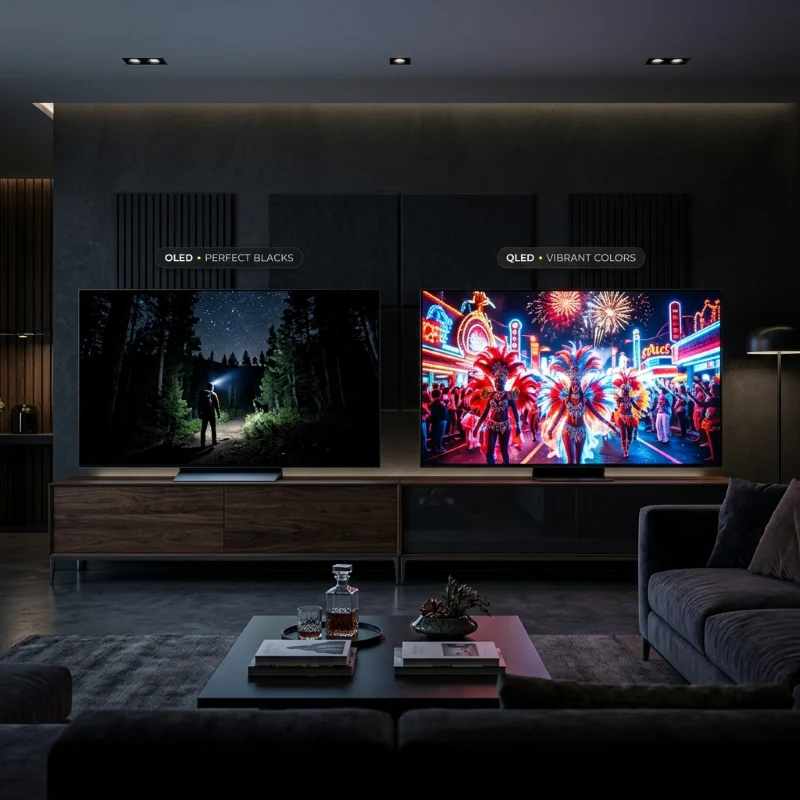
3. The Showdown: OLED vs QLED – Which One Wins?
Let’s see how they compare in the real world.
In a Bright, Sunny Lebanese Salon
Winner: QLED
If your living room has massive glass doors and direct sunlight, an OLED screen might struggle to fight the glare. A QLED’s extreme brightness easily punches through daylight, ensuring you can still see the football match perfectly at 2:00 PM.
In a Dark, Cinematic Movie Room
Winner: OLED
If you primarily watch Netflix at night with the lights off, OLED is the undisputed king. A QLED will always have a slight glow in the dark parts of the screen (because the backlight is still on). With OLED, the dark space of a movie scene is perfectly, beautifully black.
For Hardcore Gamers
Winner: Tie (Leaning OLED)
Both technologies offer 120Hz refresh rates required for the PS5 and Xbox Series X. However, OLED has an instantaneous response time, making movement feel incredibly fast and fluid.
Burn-In: Is it a Risk?
**Winner: QLED**
Because OLED uses organic compounds, there is a very small risk of “burn-in”—a permanent ghost image left on the screen if you leave a static image (like a news ticker) on for thousands of hours. QLED is immune to burn-in, making it the safer choice if the TV is going to be left on 24/7 as background noise.
—
## 4. The Final Verdict from Afif Itani
There is no “perfect” technology; there is only the perfect TV for *your* specific room.
Buy OLED if you want the absolute best cinematic picture quality, deep blacks, and a premium movie-watching experience in a relatively dark room.
Buy QLED if your room is very bright, if you leave the TV on the news channel all day, or if you want punchy colors at a more accessible price point.
No matter which technology you choose, Afif Itani & Sons has you covered. We stock the latest authentic OLEDs from LG and Sony, and the brightest QLEDs from Samsung and TCL—all backed by official warranties in Lebanon.
Browse our TVs online or visit our showroom to see the difference between OLED vs QLED with your own eyes!
—
Q: Which is more expensive, OLED or QLED?
A: Generally, OLED TVs are more expensive because the manufacturing process is highly complex. QLED technology spans a wide range of prices, from highly affordable TCL models to premium 8K Samsung models that rival OLED prices.
Q: In the debate of OLED vs QLED, does OLED use more electricity?
A: Actually, OLED often uses less electricity because it completely turns off pixels to create black, whereas a QLED backlight is constantly drawing power. However, both are very energy efficient.
Q: Can you fix screen burn-in on an OLED?
A: Permanent burn-in cannot be fixed. However, modern OLEDs from LG and Sony have highly advanced software that shifts pixels and runs cleaning cycles to prevent burn-in from ever happening under normal viewing conditions.